


English
- English
- Portugal
- 日本語
- Русский
- SaudiArabia
- 한국어
- Português
- ภาษาไทย
- Español
- Tiếng Việt
Large Diameter ERW Tube Mill for Steel Pipe Manufacturing
Time: 2026-09-20 09:20:39
Author: HEBEI AIS MACHINERY EQUIPMENT
Click:
Why Are More Customers Investing in Large Diameter Tube Mills?For many steel pip
Why Are More Customers Investing in Large Diameter Tube Mills?
For many steel pipe manufacturers, expansion follows a similar path.
They begin with a tube mill producing pipes below 168mm, serving furniture, construction, greenhouse, or light industrial markets. As customer demand increases, larger projects require stronger and wider steel pipes that small mills simply cannot produce.
A large diameter ERW tube mill allows manufacturers to enter higher-value markets while making better use of existing factory resources such as coil handling, packaging, and quality inspection.
Where Are Large Diameter Steel Pipes Used?
Large diameter steel pipes are mainly used in projects that require high strength, large load capacity, or high-volume fluid transportation. Compared with small diameter pipes, they are commonly used in heavy industrial and infrastructure applications rather than light construction.
Typical applications include:
✅Steel structure construction: Building columns, warehouses, stadiums, bridges, and industrial workshops.
✅Water transmission pipelines: Municipal water supply, drainage, and irrigation projects.
✅Oil & gas transportation: Long-distance pipeline systems and energy infrastructure.
✅Energy and foundation projects: Wind power towers, solar piling, port engineering, and other heavy-duty foundations.
As these industries continue to grow, many pipe manufacturers are expanding their product range by adding 168mm and larger ERW tube mills to meet the increasing demand for large diameter welded steel pipes.
Main Equipment of a Large Diameter Tube Mill
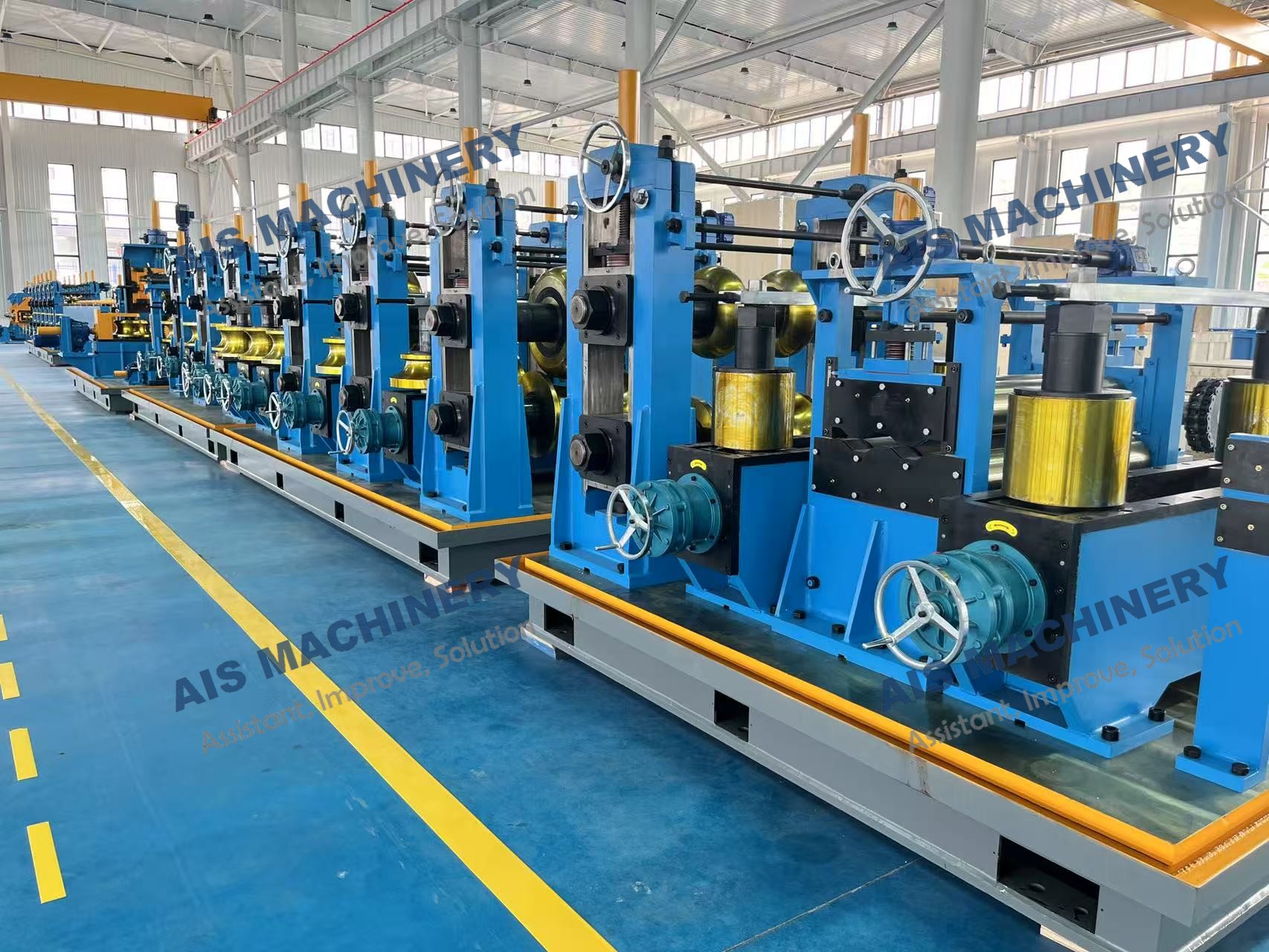
A large diameter ERW tube mill uses heavier-duty equipment than a standard small tube mill to handle wider and thicker steel coils. The typical production line includes the following six main sections:
| Equipment | Function |
| 1. Single Side Uncoiler with Peeler & Hold Down Roll | Supports heavy coils, opens the strip safely, and feeds it smoothly into the line. |
| 2. Pinch & Leveling Machine | Removes coil set and levels the steel strip for stable forming and better weld quality. |
| 3. Semi Auto Shear and Welder | Cuts the tail of one coil and welds it to the next, allowing continuous production with less downtime. |
| 4. Forming & Sizing Section | Gradually forms the strip into a tube, completes sizing, and ensures accurate diameter and straightness. |
| 5. Solid State H.F. Welder (400kW and Above) | Heats and welds the strip edges using high-frequency resistance welding, suitable for thicker-wall large diameter pipes. |
6. Cold Saw / Milling Saw | Cuts finished pipes to precise lengths with clean end faces. The cutting solution is selected according to the pipe size and production requirements. |
Is It Better to Upgrade from a Small Tube Mill?
For manufacturers who already produce small pipes, adding a large diameter production line is often a practical expansion strategy.
Advantages include:
Enter larger structural and infrastructure markets
Produce higher-value steel pipes
Share existing factory space and supporting equipment
Expand product range without replacing current production
Rather than replacing a small tube mill, many factories operate both lines together, allowing them to serve customers with a much wider range of pipe sizes.


How to Choose the Right Large Diameter Tube Mill
Before selecting a machine, customers should prepare several key parameters:
●Maximum pipe outside diameter
●Wall thickness range
●Steel material (Carbon Steel, GI, etc.)
●Required production speed
●Final pipe application (Structure, Water, Oil & Gas)
These specifications determine the forming design, motor power, HF welder capacity, and cutting system.
Start Your Large Diameter Tube Mill Project
If you're planning a new large diameter pipe project, AIS Machinery is ready to help. We provide customized technical solutions based on your required pipe size, thickness, and production capacity. Our engineers can also design a CAD layout according to your factory space, ensuring the production line fits your workshop efficiently. From machine selection to professional online technical guidance and after-sales support, we'll support your project from start to finish.
☑️Welcome to contact us for a customized solution and quotation.

Tel/Whatsapp/Wechat number
0086-151-76910262
Email Address
Linda@aismachinery.com
Tel/Whatsapp/Wechat number
0086-151-76910262
Email Address
Mia@aismachinery.com
 Company Address:RM604 SHENXING BUILDING, NO. 539 XINHUA ROAD, SHIJIAZHUANG CITY, HEBEI, CHINA CN
ZIPCODE: 050000


Copyright By © AIS Machinery-2020
Submit Information
Contact us

点击右上角
分享给朋友吧



